One-, Two-, Three- and Four-Side-Open Exhibition Stalls: What Changes?
Understand how one-, two-, three- and four-side-open exhibition stalls differ in access, sightlines, branding, visitor flow and layout planning.
Contents
- At a glance
- What do the common terms mean?
- How do you design a one-side-open stall?
- What changes with a two-side-open corner?
- How should a three-side-open stall be approached?
- How do you design a four-side-open island?
- How do open sides affect fascia and branding?
- What should be checked before approval?
- Adapt a design when the open sides change
- Frequently asked questions
- Is a corner booth always two-side open?
- Is a three-side-open booth always a peninsula?
- Is an island automatically the best configuration?
- Do open sides determine how high the stall can be?
- Design for the approaches that matter
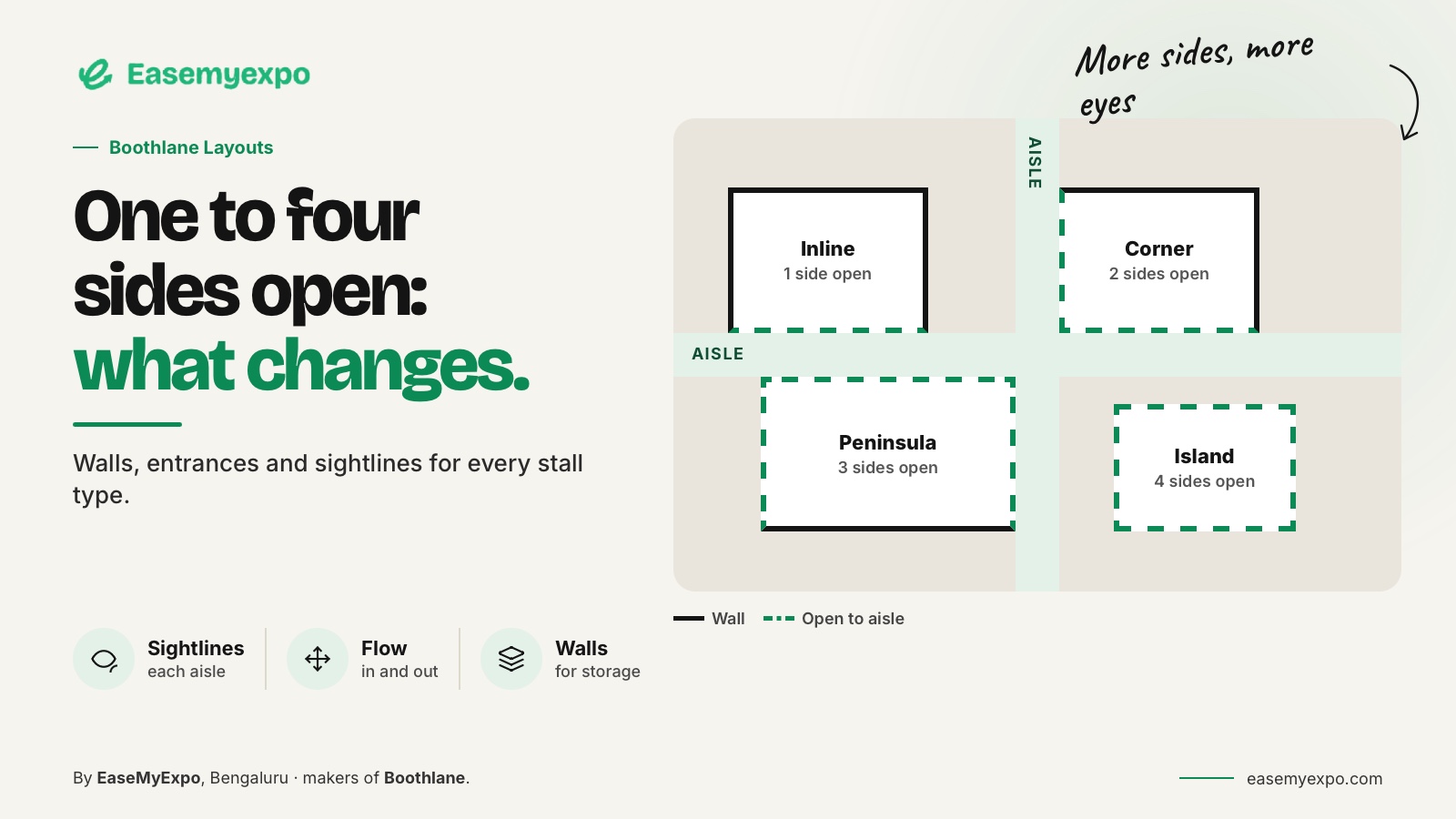
The number of open sides describes how a stall meets surrounding aisles: a one-side-open booth usually has a single aisle-facing approach; a corner often has two; a peninsula commonly has three; and an island has four. Confirm the organiser's terminology and booked plan because names alone do not establish the exact layout or construction permissions.
Open sides affect more than access. They change where the brand is seen, how displays are arranged and which views must be considered during design review.
At a glance
One open side concentrates entry at the front; a corner adds a second approach. Three-sided and island stands need several readable arrival views. More exposed edges also mean fewer obvious places for storage and rear-facing elements.
Start from the booked plan, not the label alone.
What do the common terms mean?
Freeman describes inline booths with a typical single aisle exposure, peninsulas with three exposed sides and islands with four. Those definitions are useful starting points, not a substitute for the actual booking arrangement.
Freeman exhibit stand design guidance
Common configurations include:
- One side open — Inline or linear: How will the single approach communicate the whole booth?
- Two adjacent sides open — Corner: How will two approaches lead to one understandable layout?
- Three sides open — Peninsula or related configuration: Where can the main brand and functional zones sit without confusing the entries?
- Four sides open — Island: How will the design work from all directions?
Event terminology can distinguish end-caps, peninsulas and split islands more precisely. Read the actual plan and rules rather than assuming these categories are interchangeable.
How do you design a one-side-open stall?
Treat the aisle-facing view as an important first impression, but do not let the frontage become a barrier.
Decide where a visitor can pause and how the product story continues once they engage.
Position displays according to the interaction, not simply along every available wall. A reception counter may help some briefs and obstruct others.
Test:
- The main aisle-facing view
- Visitor entry
- Product visibility
- Staff position
- Storage access
- Interior movement
- The demonstration area
Check the interior view as well as the front render. A stand can look complete from outside while feeling cluttered or confusing from the position where a demonstration actually happens.
What changes with a two-side-open corner?
A corner creates two approaches that need to make sense together.
Review the branding from both directions and decide whether one route should be the main arrival point. Do not assume visitors will approach from the camera angle used in the pitch.
For an illustrative corner design, compare locating the main display near the corner with locating it deeper in the stand.
Keep the required product dimensions fixed and examine how conversations and entry are affected.
The goal is not necessarily to make both sides identical. It is to ensure that both views communicate the booth clearly.
How should a three-side-open stall be approached?
Three exposed sides can create several ways to encounter the stand.
Decide which areas should remain visually open and which function needs a more defined setting, such as storage or a meeting zone.
Do not assume all three-side-open stands have identical construction rights. GES's event-specific definitions and regulations distinguish configurations and include conditions tied to the show.
Use them as an example of why organiser confirmation matters, not as rules for another event.
GES booth regulations and definitions
In the model, inspect the brand and product hierarchy from all relevant approaches.
A strong central feature should support the brief rather than obscure the areas visitors need to understand.
How do you design a four-side-open island?
An island has no single guaranteed front.
Build a clear relationship between the brand, product displays and activity zones from multiple directions. Decide whether the main message is repeated, distributed or concentrated in a central element.
Test how the booth reads when approached from each side.
Check whether the back of a display becomes another visitor's first view. Surfaces that were invisible in a front-oriented concept may now need intentional treatment.
More open sides do not automatically mean more useful engagement. The design still needs a clear purpose, understandable interactions and staff able to deliver the intended experience.
How do open sides affect fascia and branding?
Review the fascia as part of the whole stand.
A treatment that works over a single frontage may become visually heavy when repeated around an island. A sign can also compete with product displays if every approach has a different message.
Boothlane's documented catalogue includes fascia options for one- through four-side-open stalls and custom fascia creation.
Boothlane by EaseMyExpo launch coverage — EVENTFAQS
Use those as starting tools, then judge the actual design from the booked approaches.
Use the real artwork and keep its proportions. Do not stretch a logo merely to fill an additional side.
What should be checked before approval?
Compare plan and eye-level views for every open side.
Check:
- Branding visibility
- Product visibility
- Visitor approaches
- Staff access
- Storage
- Rear-facing surfaces
- Object dimensions
- Main interaction zones
- Which technical questions still need organiser or fabricator review
Do not infer height allowances, hanging permissions or structural requirements from the number of open sides. Those belong to the applicable event documents and technical review.
A complete visual review should explain why the chosen arrangement works for the specific brief, rather than relying on a booth-type label as a design solution.
Adapt a design when the open sides change
Suppose a hypothetical exhibitor moves from a corner location to a four-side-open island at the next show.
Reusing the old back wall unchanged may create an unattractive rear approach or block a useful route.
The same furniture can remain relevant, but its relationship to visitors needs reconsideration.
Start by identifying every element that previously relied on a closed edge:
- Storage
- Screen backs
- Cable routes
- One-sided graphics
- Meeting areas
- Service zones
Decide whether each element should move, receive a finished reverse side or be replaced.
Then inspect each aisle approach rather than simply rotating the original hero view.
The reverse move also needs work. An island concept placed in a one-side-open stall can lose the routes that made it function.
Keep reusable components, but rebuild the arrival sequence around the booked opening.
This illustrates a design adaptation method; it does not establish permission for any particular wall, suspended sign or construction at the new event.
Check every exposed rear surface. A panel concealed in one layout may face an aisle in another.
Frequently asked questions
Is a corner booth always two-side open?
That is a common arrangement, but confirm the actual booking plan and organiser's terminology before designing.
Is a three-side-open booth always a peninsula?
Not in every event's terminology. Some manuals distinguish end-caps, peninsulas and split islands. Use the applicable definition.
Is an island automatically the best configuration?
No. Suitability depends on objectives, space, products, staffing and the design. Four approaches create different demands, not a universal advantage.
Do open sides determine how high the stall can be?
Not by themselves. Check the current event and hall requirements and obtain the relevant approvals.
Design for the approaches that matter
Use Boothlane to build the booked configuration and review the booth from every side your visitors can approach.